Feature Friday: Advancing Archaeology Through Collaboration
Posted March 27, 2026 in Educational Technology News, Feature Friday, Featured News, Giving to JMU Libraries News, JMU Libraries News, The Makery News
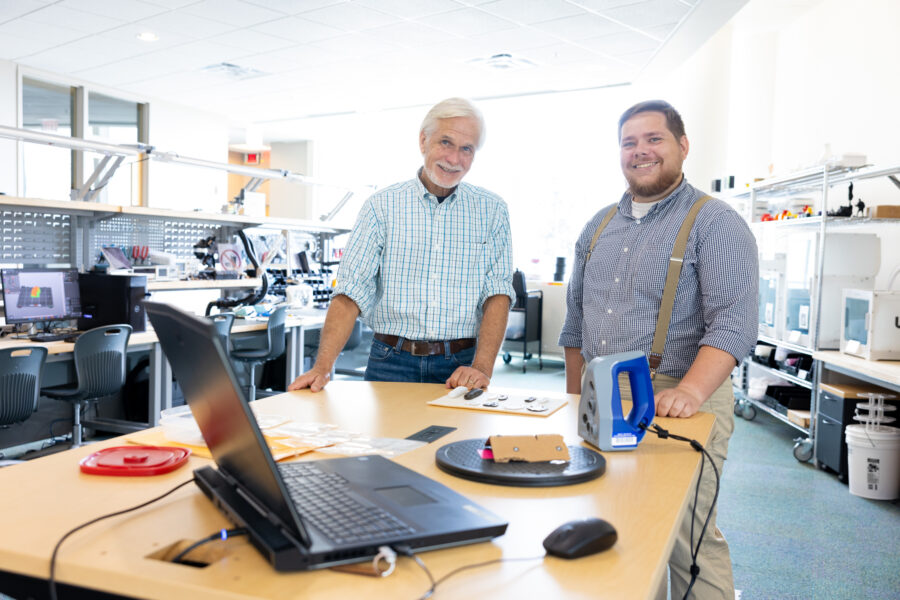
When Dr. Dennis Blanton reflects on his career at JMU, one theme stands out: collaboration.
As a professor of anthropology preparing for retirement this spring, Blanton has spent decades uncovering the stories of the past—most recently through research on early encounters between Indigenous communities in Georgia and Spanish explorers. But in the last several years, some of the most transformative breakthroughs in his work have been accelerated or even made possible through partnerships within JMU Libraries.
What began as a simple email inquiry has grown into a multi-year collaboration with the Libraries’ Media Production and Makerspace Services (MPMS) team—one that Blanton describes as a “game changer.”
Turning Overwhelming Data into Usable Discovery
Blanton’s first collaboration with the Libraries began in 2022 with an enormous challenge: processing massive LiDAR datasets from his “Deer Run” archaeological project in Georgia.
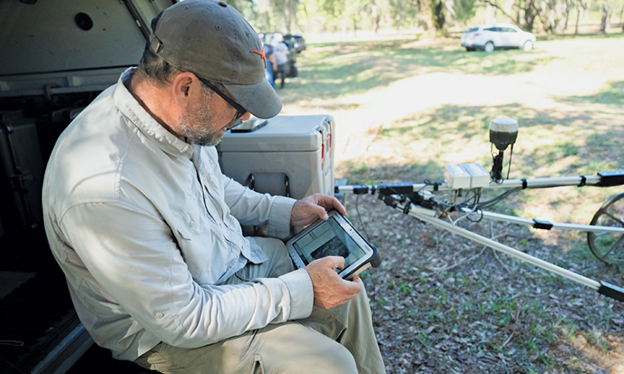
LiDAR (Light Detection and Ranging) technology produces highly detailed laser-based scans of the Earth’s surface. For archaeologists, it’s revolutionary—revealing subtle landscape features invisible to the naked eye. But the sheer size and complexity of the data can be overwhelming.
“I had these remarkable images,” Blanton recalls, “but they were impractical to use the way I needed.”
He reached out to the Libraries and connected with Andrew Strack, who helped convert the massive point-cloud files into manageable, high-quality images Blanton could efficiently analyze. The result? Significant time savings and accelerated research progress.
Rather than treating the request as a routine task, Strack embraced it as an opportunity to learn alongside Blanton. That spirit of intellectual curiosity, Blanton says, embodies the best of the university model.
“There’s this academic village,” he explains, “full of people with expertise none of us could ever hope to master. Through these interactions, we move the ball much farther—and more efficiently—than we could alone.”
Preserving the Past Through 3D Scanning and Printing
Blanton’s work with the Libraries expanded in 2023 and 2025 to include 3D scanning and printing archaeological artifacts in collaboration with makerspace staff including Adam Wirdzek and Jared Wark.
Archaeological finds are rare and fragile. Passing them around a classroom—or even among colleagues at a conference—can risk permanent damage.
3D scanning offered a solution.
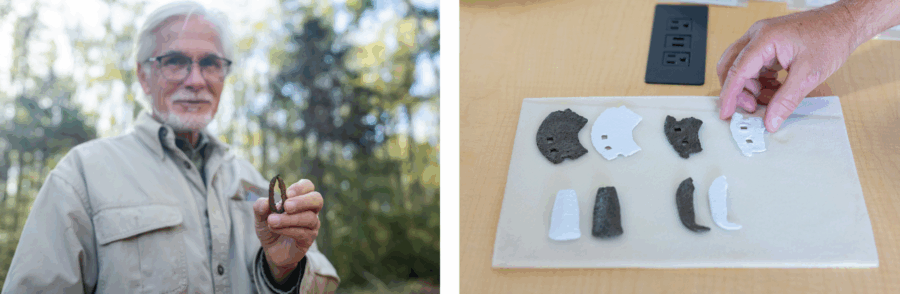
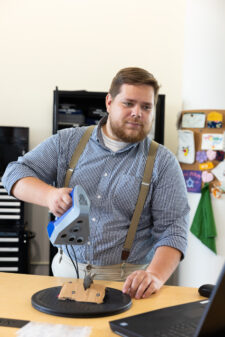
Using specialized scanners in the Libraries’ makerspace, staff created precise digital models of artifacts, which were then transformed into detailed 3D-printed replicas. Painted and finished, the replicas closely resemble the originals in size and appearance.
The impact has been twofold:
- In the classroom: Students can handle and closely examine objects without risking damage to irreplaceable artifacts.
- In professional settings: Blanton can share replicas with colleagues at conferences and seminars, enabling collaborative analysis without transporting delicate originals.
“It would be irresponsible to pass around the real object,” he says. “But with these facsimiles, I can comfortably let students and colleagues experience them firsthand.”
For students, that tactile engagement deepens understanding. For the artifacts, it ensures preservation.
Capturing Craft and Knowledge on Video
Blanton’s collaborations also extended into video production and editing.
As part of his research into iron artifacts brought by Spanish explorers and traded to Indigenous communities, Blanton partnered with a master blacksmith at Colonial Williamsburg to recreate historical forging techniques.
Wanting to preserve the process for both students and scholarly peers, he borrowed professional video equipment from the Libraries and traveled with a student assistant to document the experiment. The student served as videographer and later received prominent credit in the final production—an experience Blanton describes as meaningful professional development.
After filming, Blanton turned again to the Libraries for help—this time working closely with Jenna Polk to transform hours of footage into a polished teaching video.
“The end result was exactly what I imagined,” he says. “And I’ve been able to use it in all the ways I hoped.”
Elevating Scholarship Through Design Expertise
Publishing in academic journals often comes with stringent formatting and graphics requirements—precise fonts, line weights, resolutions, and layout standards. While Blanton could create basic graphics, achieving publication-ready polish required specialized design expertise.
With support from Craig Baugher, Blanton refined his illustrations to meet exacting publisher guidelines.
“It introduced efficiency,” Blanton says. “And the graphics were dynamite. There’s no way I could have duplicated what he did.”
One Place, Many Possibilities
A consistent theme in Blanton’s experience has been the convenience and synergy of having these services consolidated within JMU Libraries.
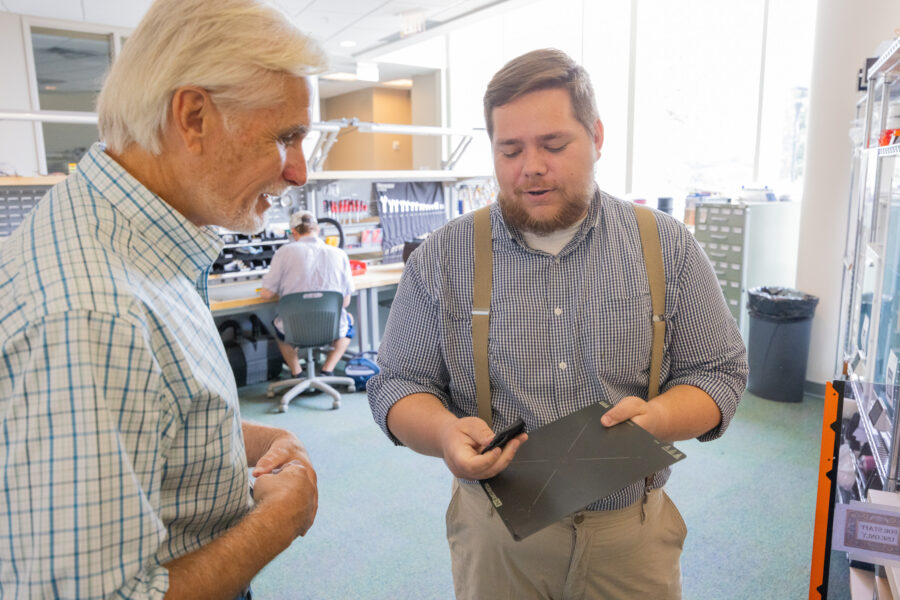
Whether visiting Rose Library to consult with specialists or working in the makerspace, he found an environment where collaboration happened naturally—where colleagues overheard conversations and stepped in with additional ideas and expertise.
“It simply could not be more convenient,” he says.
Blanton compares the experience to outstanding customer service in the business world, but rooted in academic values: shared curiosity, mutual respect, and a commitment to advancing knowledge.
A Message to Faculty—and a Hope for the Future
As he prepares for retirement, Blanton encourages fellow faculty to take full advantage of what JMU Libraries has to offer.
“You’re making a mistake if you don’t avail yourself of these opportunities,” he says. “The expertise here is amazing.”
He also hopes his emeritus status will allow him to continue collaborating.
“Retirement may be in name only,” he laughs. “I plan to keep researching. And it would be wonderful to keep working with these folks.”
For JMU Libraries, Blanton’s story highlights something powerful: when faculty bring their questions—whether about LiDAR data, 3D artifacts, video production, or publication graphics—the Libraries are ready to explore possibilities for working together.
What begins with a simple inquiry can blossom into years of partnership, innovation and shared discovery.
And in JMU’s culture of collaboration, scholarship thrives.
This story is part of the JMU Libraries Feature Friday series. If you’d like to recommend a person or project connected with JMU Libraries to feature in this series, contact us at libraries@jmu.edu.
Learn more about Media Production Support for Faculty at JMU Libraries.