The Steps of the Shenandoah in Carrier Library: Rooted in the Valley, Reaching Toward Tomorrow
Posted March 24, 2026 in Carrier Renovation News
by Kristen Shuyler
Beyond the staircase, even Carrier’s walls and floors cultivate a profound sense of place and permanence. Interior Bluestone walls—the original 1930s exterior of Madison Memorial Library—provide a tactile connection to the university’s origins and the material of the valley itself. Meanwhile, JMU-themed compass roses, embedded in the terrazzo flooring inside each entrance, offer a subtle reminder of the wider world and the trajectories students may follow after graduation.
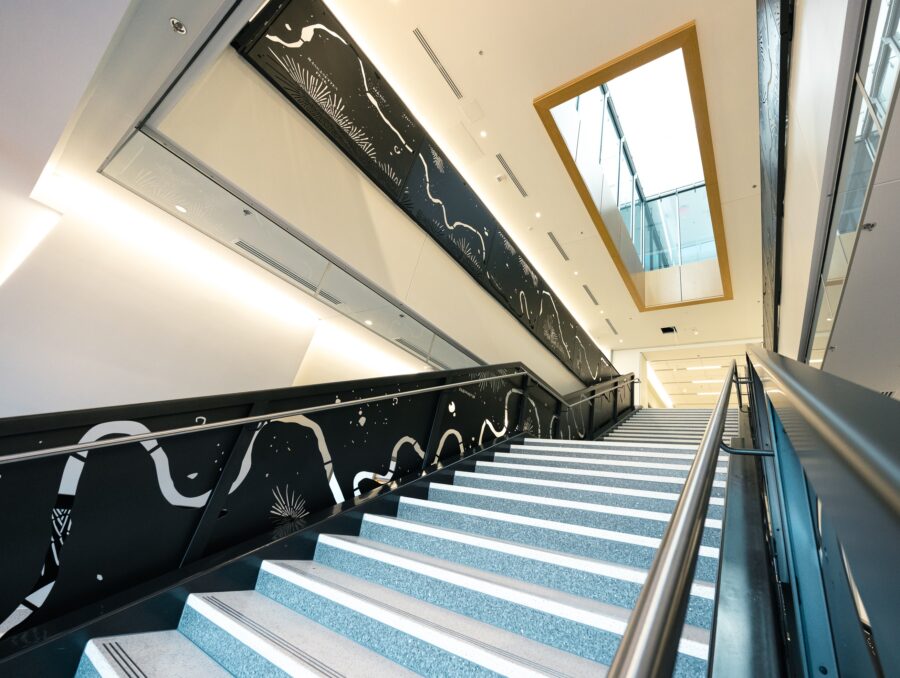
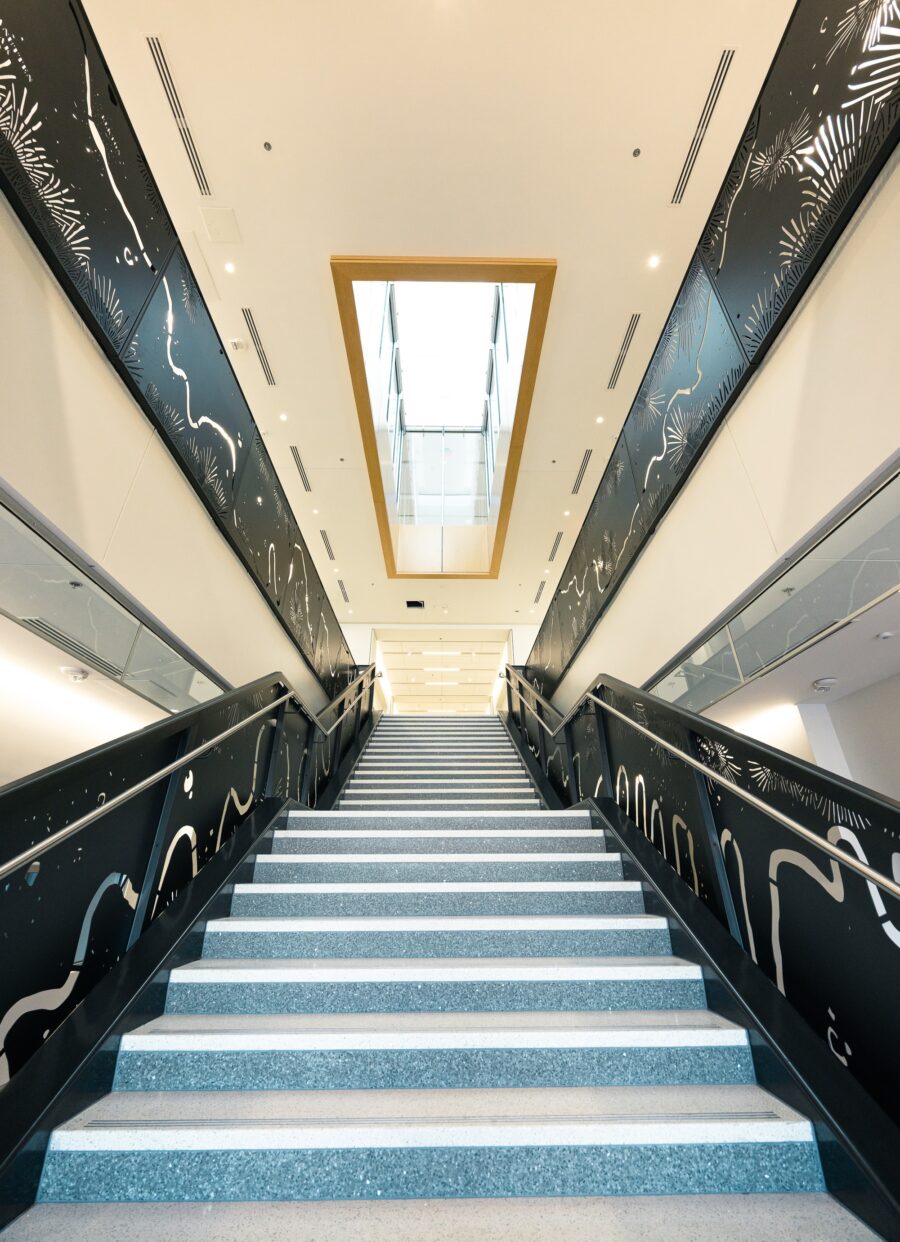
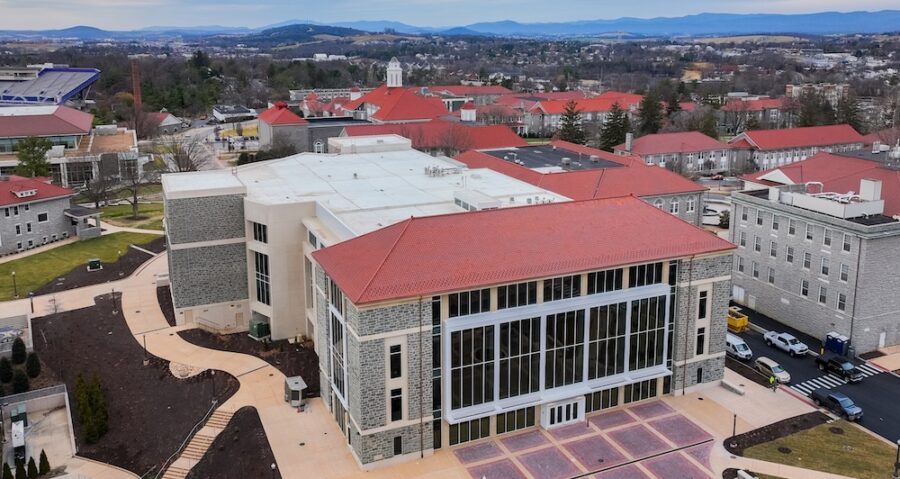
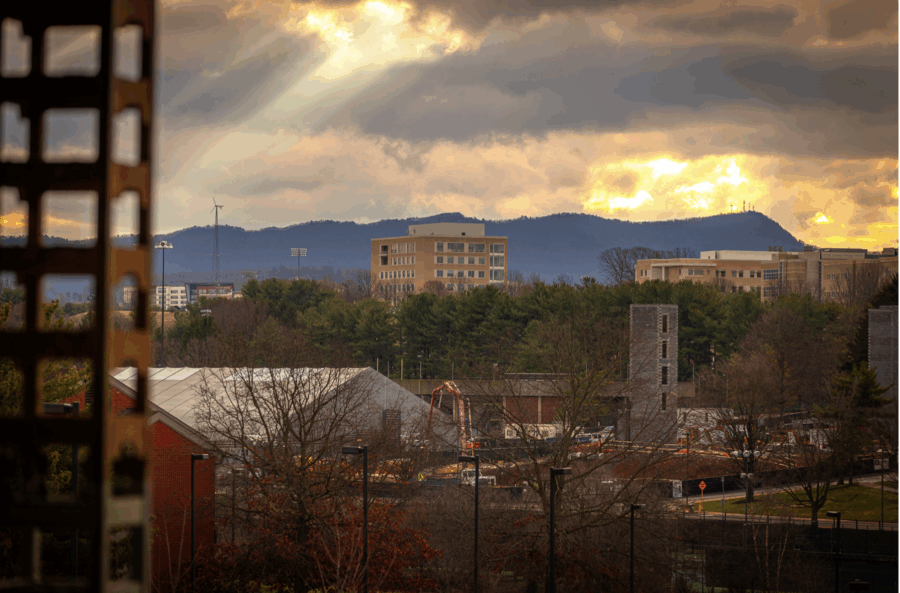
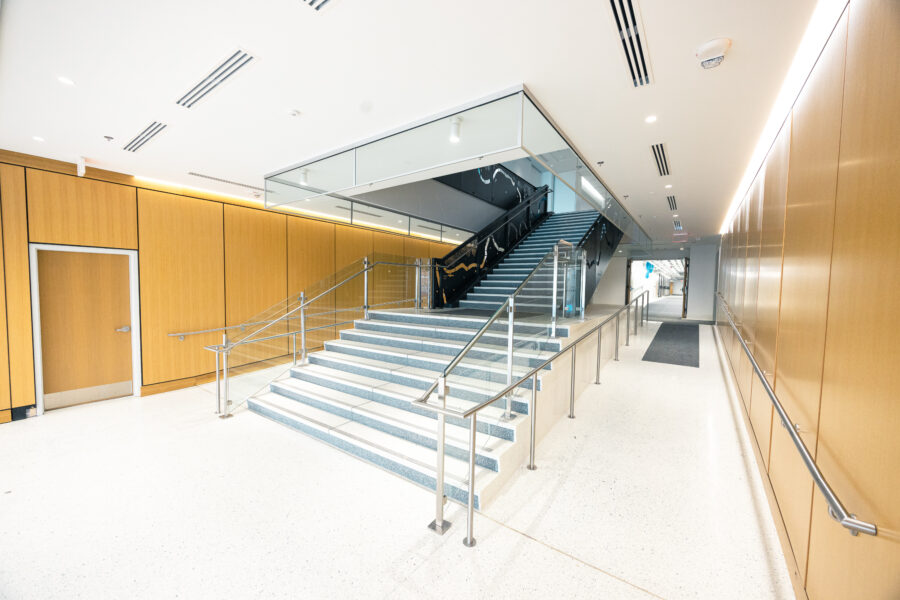
When Carrier Library reopens this August, all who step inside the Stan and Rosemary Jones Wing will be greeted by the Steps of the Shenandoah—a signature staircase that evokes the undulating path of the Shenandoah River. While this striking vertical element rises through three floors in the new wing, it symbolically grounds the library in the enduring form of the Shenandoah Valley landscape.
The implementation of these site-specific design elements in Carrier was not merely a feat of engineering, but a beautiful example of JMU’s culture of purposeful collaboration. An interdisciplinary partnership among architects, construction managers, library staff, designers, and facilities experts is precisely what allowed these place-based features to take shape within the library’s new footprint.
In an era where knowledge can feel increasingly fleeting or intangible, these intentional, locally inspired design elements in Carrier Library assert the library’s constancy and connectivity. By bridging the past, present, and future, the building serves as a reminder of the way a university and its library can be deeply integrated with its community and anchored in its local landscape.
Rising to the challenge: “Not like any other stair”
“JMU told us they wanted something unique and different” for the staircase, recalled Stephen Phillips, Senior Associate at Moseley. “We had some ideas, but we were actually challenged by Kirk Morris [Director, JMU Engineering and Construction], who wanted to make sure this was not like any other stair,” remembered Kevin M. Smith, Partner at Robert A.M. Stern Architects.
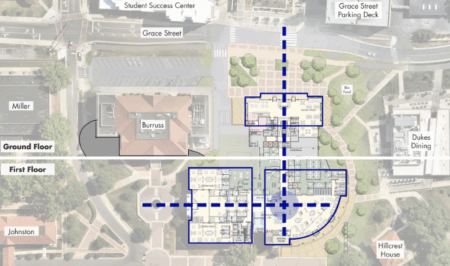
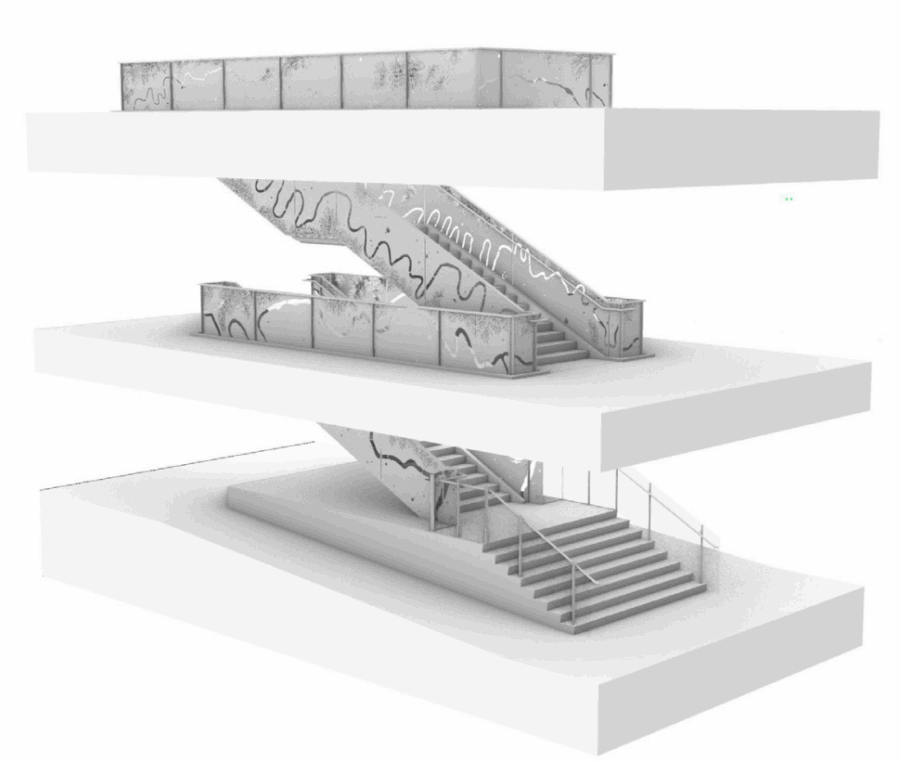
The staircase is a vital part of a major new thoroughfare in the building. The overhead site plan reveals two perpendicular lines intersecting within Carrier—physical crossroads that allow for nearly uninterrupted sightlines from one entrance to another. Because the natural topography of the land dips toward the north, one of these axes required a vertical solution to negotiate the terrain’s drop. The design team knew they needed a staircase and elevator, but because of the dedication required to meet JMU’s ambitious challenge—to create a staircase truly unique to the university and the Commonwealth—construction on Carrier began before the stair panel design was complete.
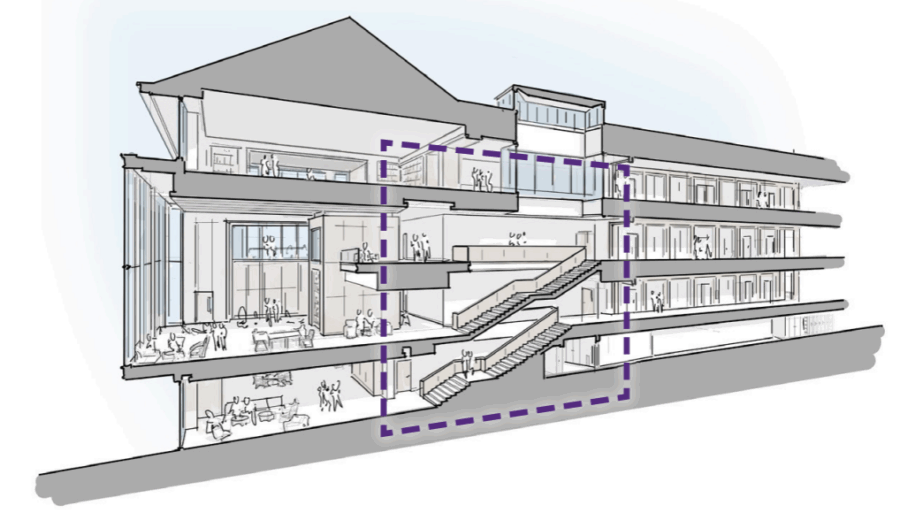
From its inception, the reimagined Carrier Library was intended as a physical manifestation of an intellectual crossroads. The building’s new intersecting pathways were engineered to improve navigation in and around Carrier, creating literal and figurative connections between different disciplines and various precincts of campus. Will Gridley, Associate Partner at Robert A.M. Stern Architects, explained that the new design of Carrier was also meant to be “much more outward looking and transparent, inviting, having the stair as a device to help support that. But the idea of translating or manifesting these natural surroundings in such a literal way in the stair’s design—that was not ever the plan. The design of the staircase panels happened after the building was designed.”
Refining the staircase design: “It’s absolutely art”
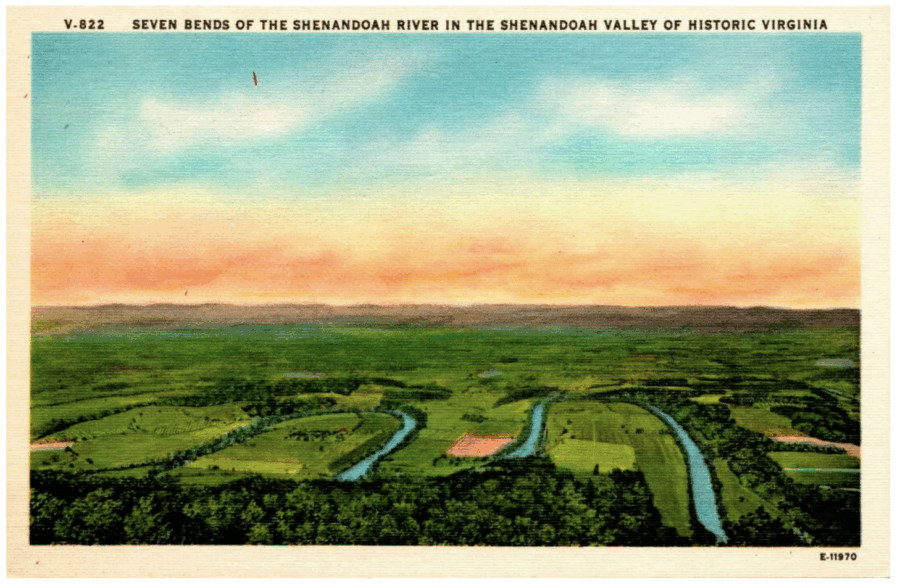
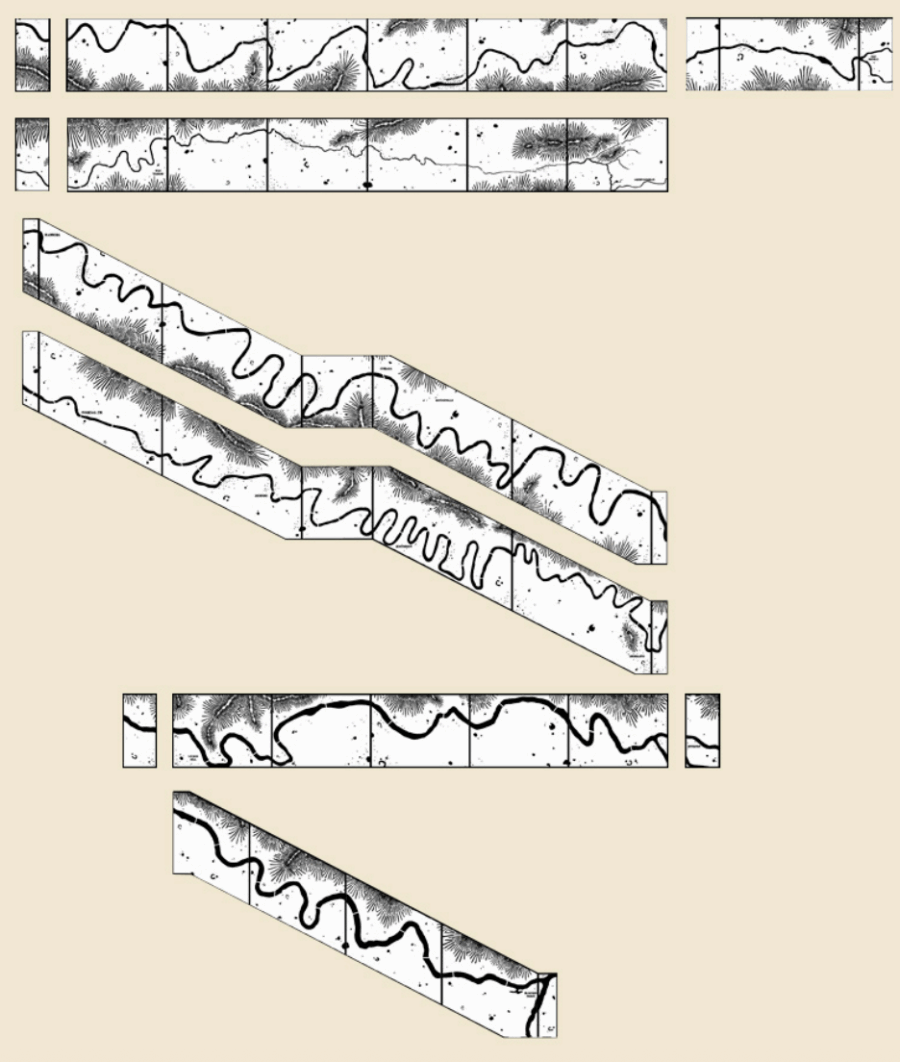
While early design concepts for the stair focused on words or text as the design motif, the team ultimately looked to the ancient beauty of our beloved Shenandoah Valley for the final design. Specifically, the Shenandoah River, which meanders north through the valley, inspired the staircase. As Bethany Nowviskie, Dean of Libraries, noted, the local geography offers a permanence that no words ever could. “This building is going to be here for the long haul. Even as a lover of language, I recognize there’s something much more enduring about the landscape surrounding JMU—carved by ancient geological processes—than any set of historicized words we might have picked,” she said.
The river design was an organic outgrowth of the desire of everyone involved to honor “the region and its natural beauty and its history,” as Gridley said, explaining that the team’s work already involved “orienting rooms in Carrier a certain way to capture certain views, and we thought, maybe this staircase is an opportunity to bring the outside in, a degree further.”
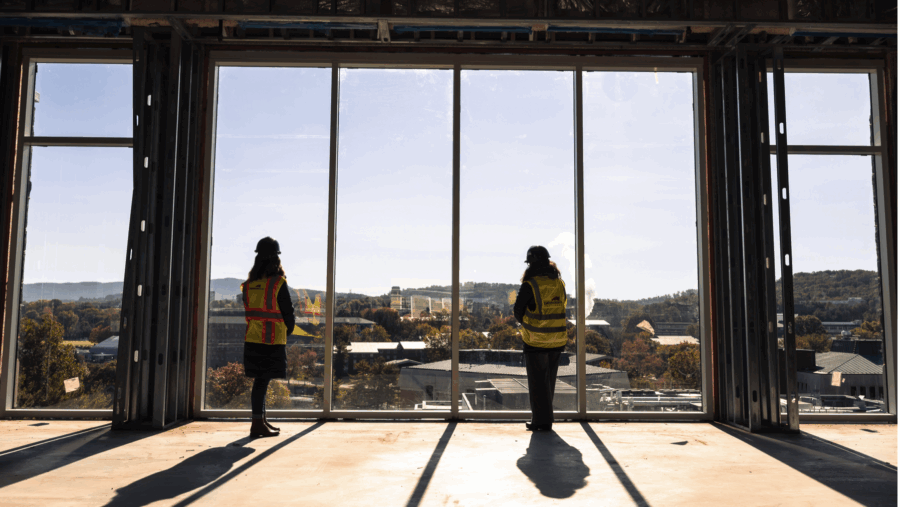
“The Shenandoah Valley is such an important piece of what is JMU,” Smith pointed out, “but you can be at JMU and actually never experience the Shenandoah River.” He added, “So this was the big, wonderful idea: now, from the library, you can see all the mountains that make up the valley, and the staircase is anopportunity to make the valley and the river present. Present in a way that’s also historical and everything that libraries should be about. Being a record.”
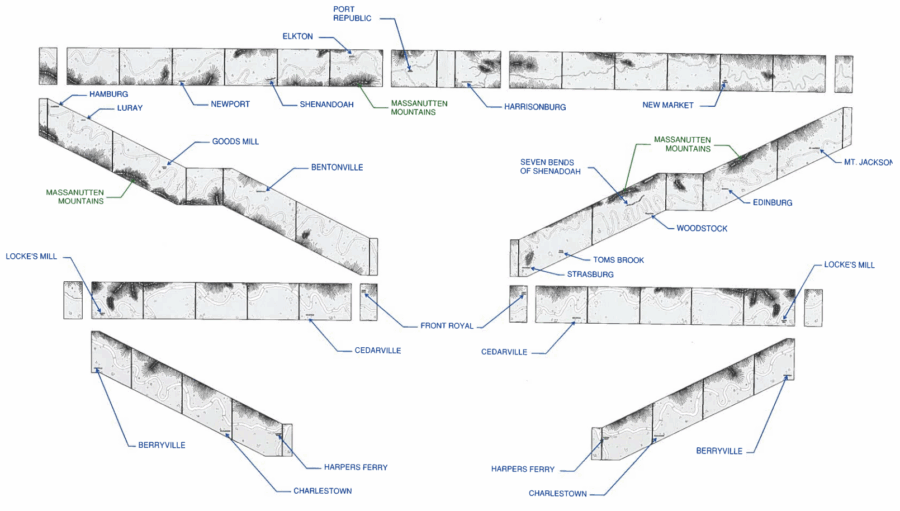
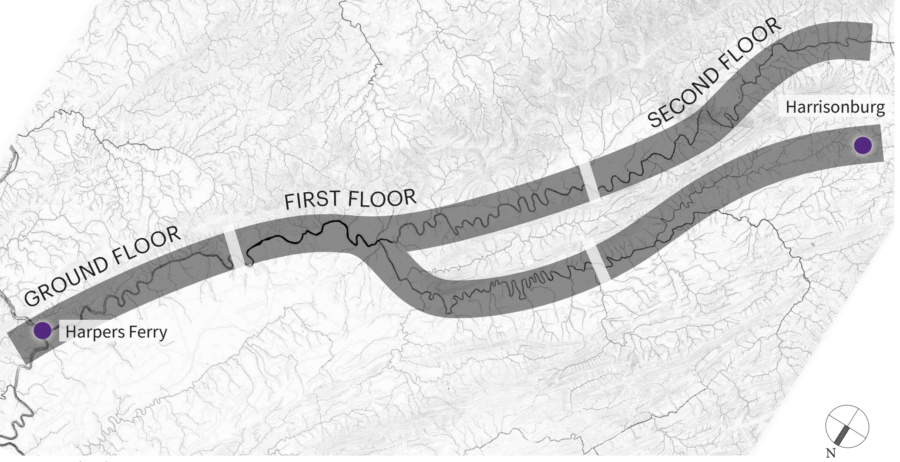
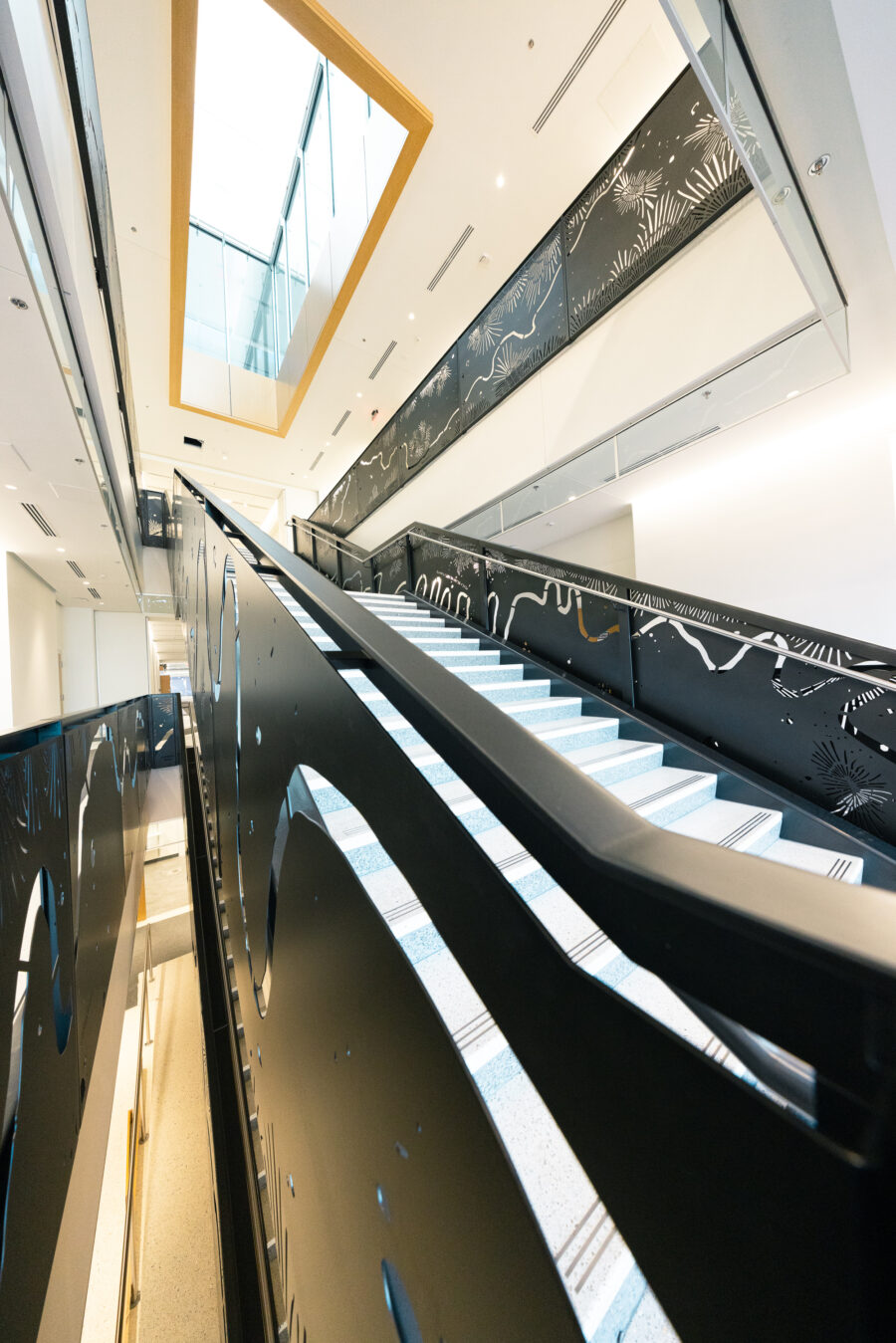
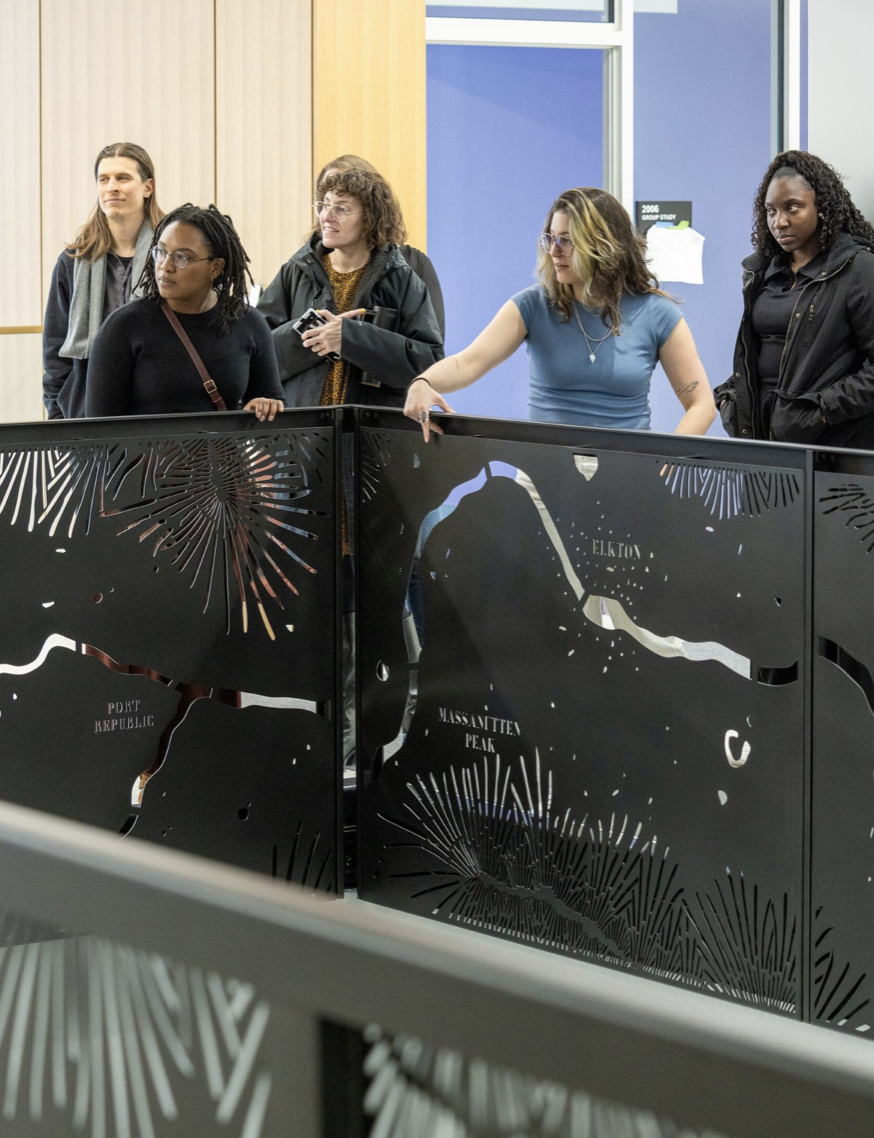
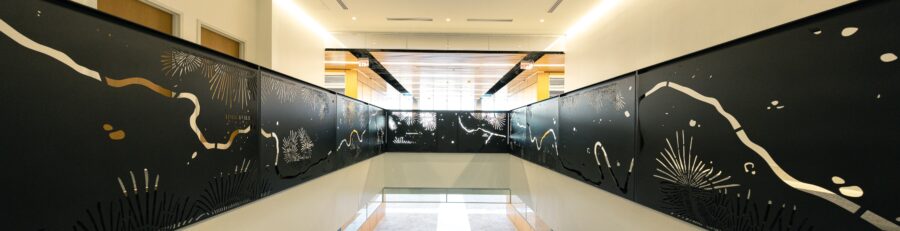
Once the concept was set, the team turned to a wide variety of documents to create the actual design. “We started looking at images—everything from photographs to old paintings to historic maps,” Gridley remembered. “It was actually the graphic motif of some of the historic maps that interested us—the way that they represented topography, mountains, rivers, and the flow of water in an abstracted way that had an interesting artistic quality.” Smith explained that each side of Carrier’s staircase railing represents one fork of the Shenandoah River: “We started looking at old maps. And the river has two forks—it’s so very cool—there are two rails of the stair, and they actually represent the two forks of the Shenandoah River as it moves its way up from the first floor to the third floor.”
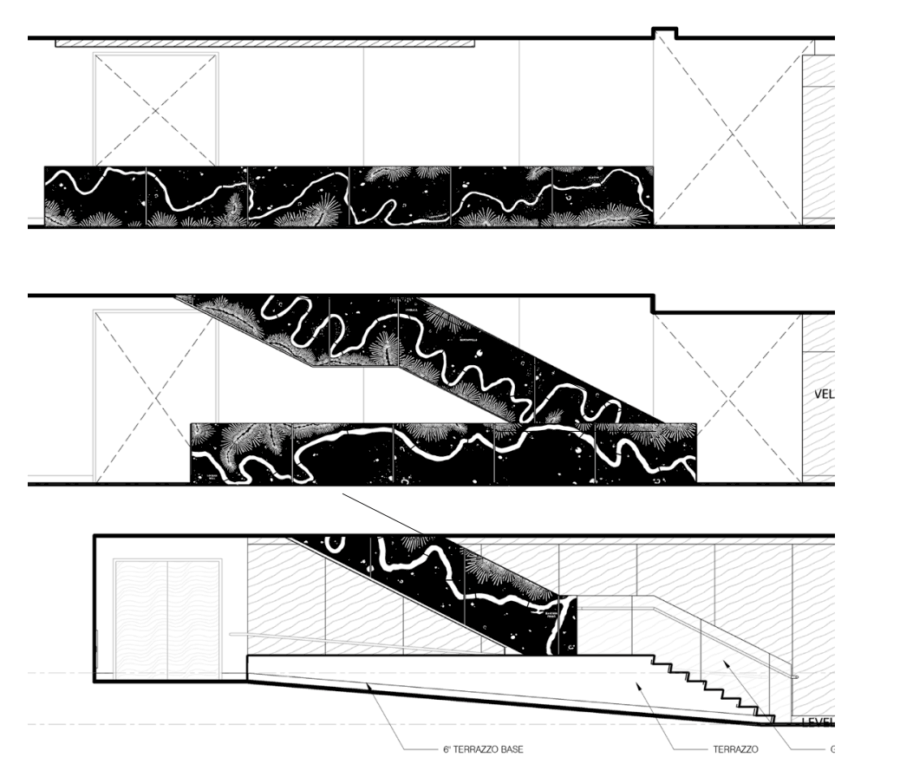
This geographic attunement extended to how the staircase sits within the library’s footprint. Glenn Wayland (‘88), Capital Outlay Project Manager in JMU Facilities Planning and Construction, noted, “We worked painstakingly on the layout, so that if you’re facing Grace Street, the right side of the staircase is actually the Page County side. And then on the left side of the staircase is the I-81 side. We wanted to make sure that layout was right.” The team took great care in choosing which place names and features to include. Brent Harlow (‘04), Senior Project Manager at Kjellstrom and Lee, Inc., noted that Wayland and Phillips, “who know the area and have been around here a long time,” helped identify which features to show, such as the Seven Bends of the Shenandoah, Massanutten Peak, and communities along the forks of the river.
Though based on historic cartography, the staircase is a one-of-kind, site-specific creation with features selected to resonate with the JMU community—many of whom will know these names from road signs along I-81. Yet, the stair is not truly a map; it’s more of a collage, “done in an artistic way” with a “poetic obliqueness,” Smith said. Harlow agreed: “It’s absolutely art.”
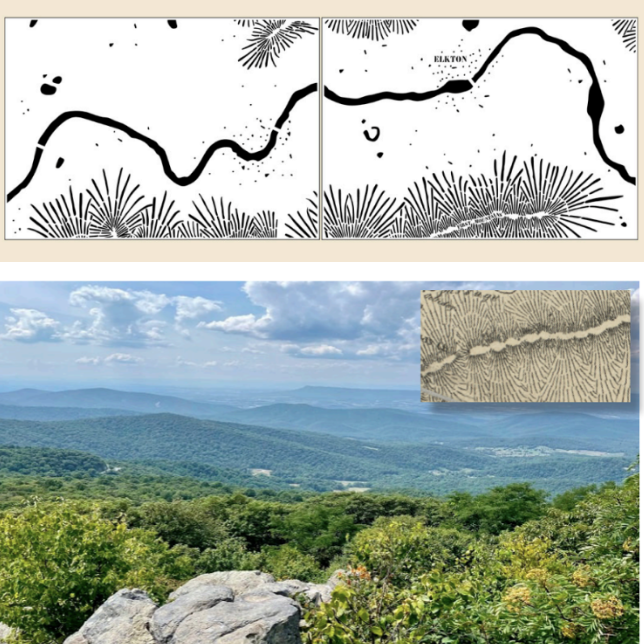
When introducing the staircase to library staff, Kelly Miller-Martin (‘06), Director of Facilities Operations for the JMU Libraries, explained that while “the river is pretty intuitive,” the representation of the mountains might require translation. “The lines, when they come to a center, represent a peak” of a mountain, she explained. Harlow added, “A lot of folk, when they see the mountains on the railing, may think they are amoebas. But back in the day, the way maps were made, the closer the lines are together, the closer you are to the peak of a hill.”
Rather than mimicking modern contour lines, the staircase adopts the more evocative, hand-drawn look of 19th-century maps. Gridley mused on the allure of this design decision: “Part of what I think is interesting about historic maps is that over time, people developed different ways of representing the land based on the tools they had. There was a time when they didn’t have precise instruments. So the way that they mapped—the result was more abstract. A collage of natural features that we think is beautiful.”
Ultimately, even the choice of source material for the design reinforces the library’s mission as a steward for knowledge across all fields. Nowviskie noted, “As a library, we have responsibility for supporting all the disciplines represented on our campus, and some of those are connected to geology and the environment and deep history in obvious and less-than-obvious ways. And so to have historic maps, geography, and geology represented in this feature of Carrier—it’s really fantastic.”
Making it work: “The team wanted a masterpiece, but…”
With the design concept finalized, the challenge shifted from the drafting table to the construction site. Phillips noted, “Once we got approval on the design, we started sharing it with the contractors who would actually be building it and putting it together. We had to figure out how we were going to get it into the building.” This transition required a delicate balance between architectural aspiration and on-site reality. Harlow explained, “What happens for us, from a construction standpoint, is when somebody has an idea, they put pen to paper. And we answer in two-fold, saying, ‘That’s awesome, I want to be a part of that, because this is a really cool idea.’ But then there’s the other side of our answer that says, ‘All right, let me logistically think about how to do this.’”
Harlow recalled the initial tension between the artistic vision and the construction schedule: “At the beginning, I had a lot of concerns. And my concerns were probably different than anyone else’s. The team wanted a masterpiece, but we also needed to maintain our project turnover date.” But during weekly meetings, the team worked through “the detailing and how it all fits together” to forge a viable path forward. Harlow continues, “We went through several iterations” of the staircase plan, noting that it was precisely this “push and pull” that helped the concept “evolve… And for me, personally it’s cool to be part of this project, because I went to school here. So, there’s that piece that I find personally intriguing.”
Building for durability with local expertise
Once the design was finalized, the search began for a partner capable of translating the vision into metal. As Harlow explained, “We needed to introduce somebody that can actually build this—a metal shop. That’s where Shickel comes into play. And Brad Billings [Assistant Project Manager at Shickel Corporation] was awesome to work with. They’re right here down the road in Bridgewater.” The local Shickel Corporation “did a fantastic job working through the design and the integrity of the panels. Just a tremendous amount of effort went into every step of it – design detailing, fabrication, and install,” Wayland said.
This collaboration was rooted in a deep, shared connection to the Shenandoah Valley. Harlow remembered, “When we pitched the idea—because they’re metal dudes; that’s what they do—they said, ‘100%, yes we can do this.’ Because it was the first time they’ve done something this cool locally.”
The collaboration also sparked a defining shift in the design’s aesthetic. When Shickel created the first sample panel in the originally planned silver color, the team realized the vision needed to evolve again. “Everybody was like, ‘Oh hell no. That is not what we’re doing,’” Harlow recalled. “Just visually, we knew, that’s not right.” Shickel pivoted, offering another sample with a dark finish and intricate cut-outs to represent the river and the contour lines. “And everybody was like, ‘Yes.’ Now we know, this is the whole direction of the staircase,” Harlow explained. The finished staircase features water-jet cut metal and a sophisticated and timeless dark powder-coat finish.
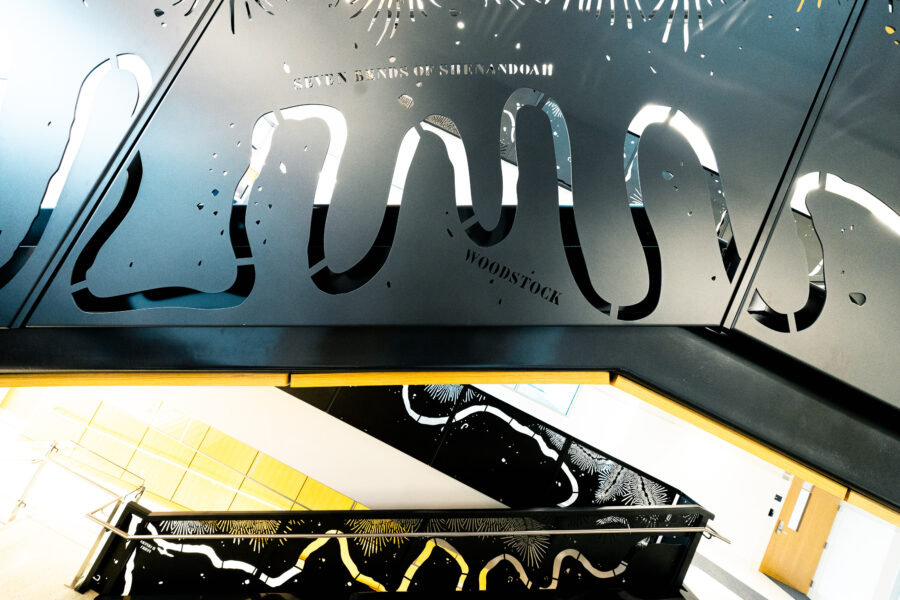
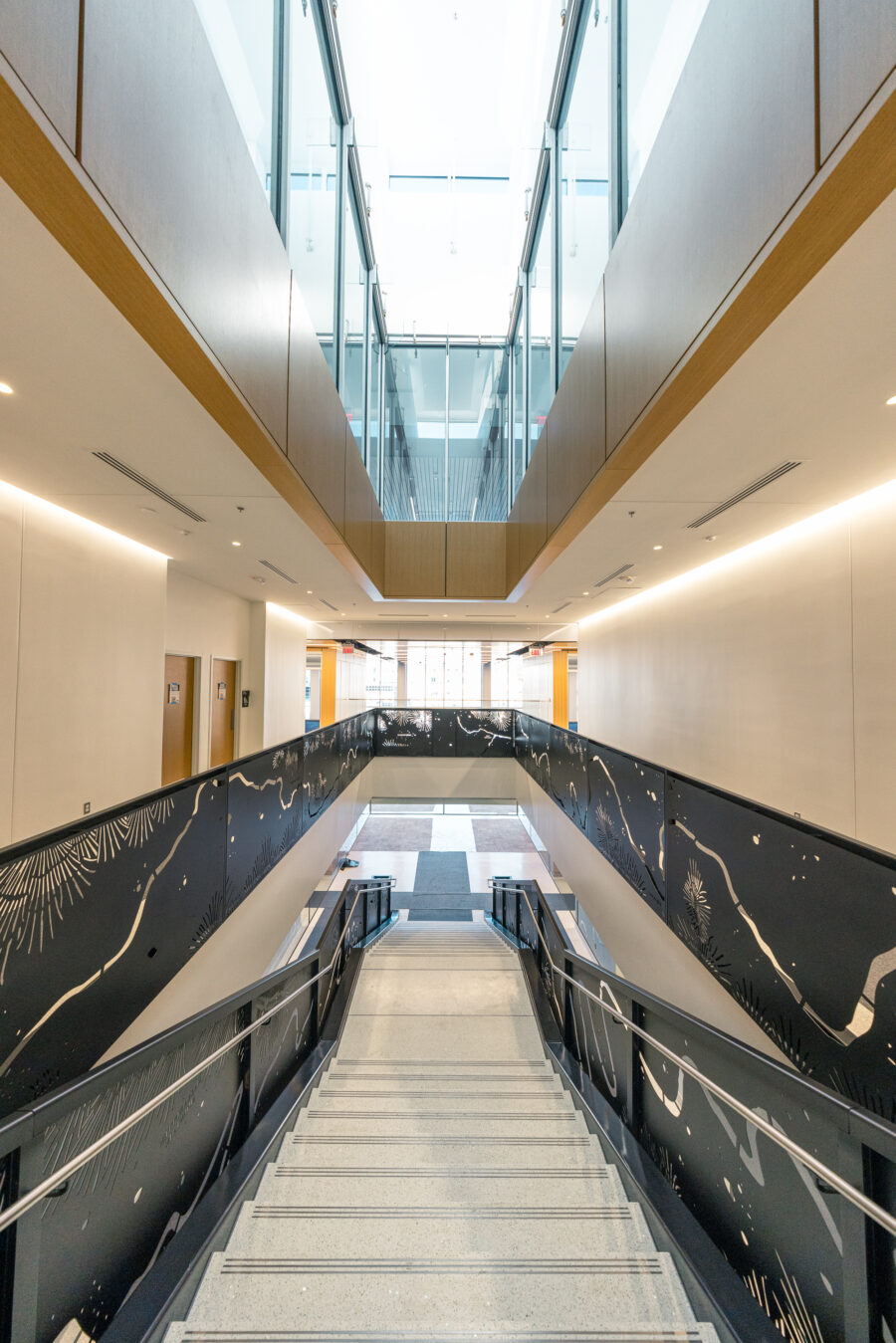
The precision of the local firm’s execution left a positive impression—and accelerated the installation process. “The design of each panel was fine-tuned,” explained Miller-Martin, “and I was so impressed at how coordinated the fabrication and install were. Even the precise way the individual panels were labeled to be delivered so they were all in order, and they fit together the way they were supposed to.” Harlow agreed: “Once the railings & brackets started arriving from Shickel, I was like, ‘There’s no doubt we got the right guys to do what we’re asking.’ It was clear.”
Beyond aesthetics, the staircase was engineered for longevity and sustainability. Wayland explained, “All the panels were installed with hidden fasteners and are independent of each other. I kept challenging the team, asking, ‘What happens if they get scratched?’ So proud of the team collectively—they figured out how to remove a panel and touch it up without having to do a lot of work to repair a damaged panel.” Phillips added, “It’s totally modular. It can be completely taken apart. Any one part can be replaced. And it’s all powder coated. That means if something gets damaged, you can pull it apart and fix it without welding.” Miller-Martin explains that this modular approach “supports us now, fifty years from now, and seventy-five years from now, in terms of the life span of this feature.”
Other unique building features: “Layering of history”
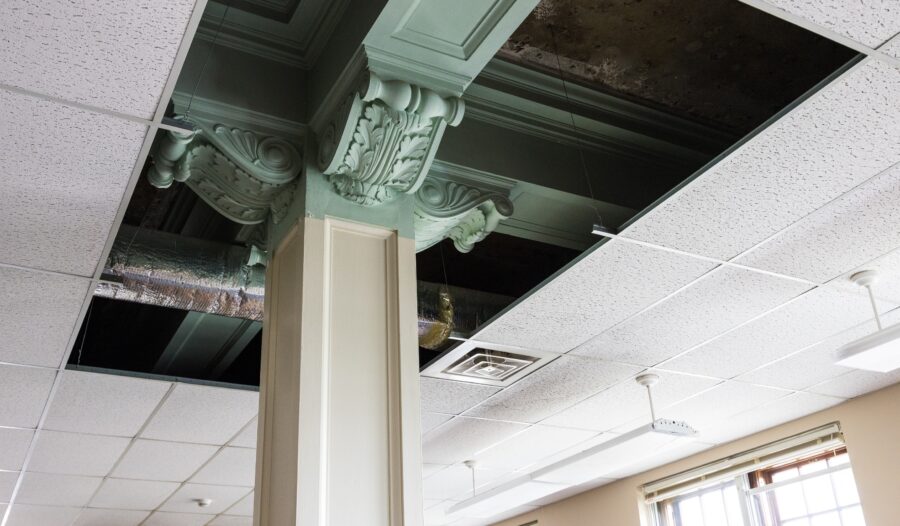
The staircase is one of several locally inspired features that connect the building to its historical roots. An early example of the project team’s commitment to historic Carrier was the restoration of column capitals and brackets that had been hidden for decades under drop ceilings. Talented plasterwork specialists preserved and restored these gorgeous 1939 elements.
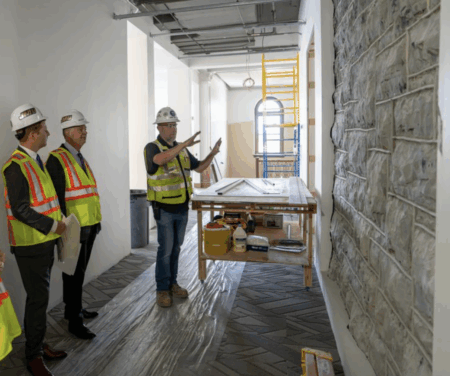
Another example of this effort was the preservation and restoration of 1930s-era Bluestone walls from the original exterior of the Madison Memorial Library, now on the interior of Carrier. As Wayland explained, “Towana Moore [JMU’s vice president for Finance and Administration] had a positive impact on the project. During one of her routine site visits, she noted that we had exposed Bluestone walls on the second level and raised the question of whether it was possible to keep them exposed for the public.”The team agreed, even sourcing original stone from the first library building—salvaged from a prior renovation—so that “stonemasons could remove stone that had been damaged or chipped, and replace it with vintage stone,” according to Wayland. As Smith reflected, “It’s wonderful that there’s this layering of history” in the renovated space.
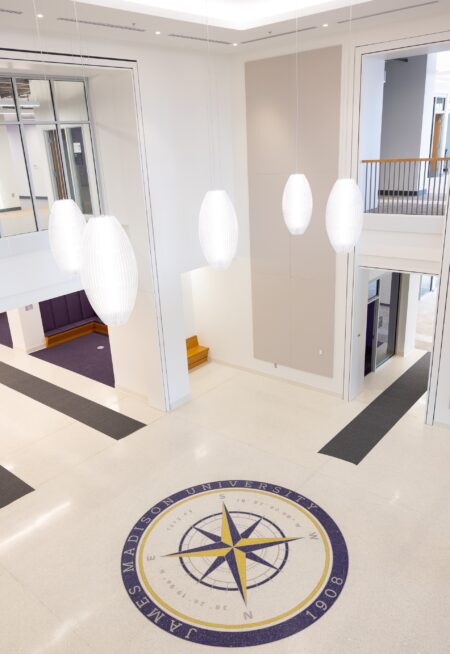
A sense of orientation in space and time extends to the library’s thresholds, where custom compass roses are set directly into the terrazzo flooring. Like the staircase, these directional markers reflect place-based themes that only grew stronger through the construction process. “They weren’t in the original design,” Phillips said. “We wanted something that would be timeless,” said Wayland. Each of Carrier’s three entrances features a compass rose, with the historic entrance boasting a larger design emblazoned with “James Madison University 1908.” These elements “tell a story about JMU students and researchers using the library to chart their own paths and find their way, to whatever it is that they’re aiming for,” said Nowviskie. Phillips observed that these elements symbolize the “library as your road map to success.”
The compass roses are more than decoration; they’re accurate to their specific location. “They’re all oriented true north. So they’re not facing the door, they’refacing north,” Phillips explained. Thanks to GPS experts in the JMU Geospatial Engineering Services department, each compass rose includes the precise latitude, longitude, and elevation of its exact location.
Reflecting on the broader resonance of these design choices, Gridley noted there is a wonderful “connection between the compass and the stair. It’s all about the subconscious experience of your place in the world.”
Collaborating and connecting: “People who love the place”
The realization of the Steps of the Shenandoah staircase — and these other unique features of Carrier Library—exemplify JMU’s culture of collaboration across and beyond campus. The project was more than just design and engineering; it was about a deeper sense of connection to place and people. Gridley noted, “I think there’s this bigger story about creating connections. And it’s connecting people and it’s connecting to the campus. It’s connecting to nature. It’s connecting the older and newer parts of the building. It’s connecting the experience of moving through a building, through a campus.”
These connections extended to the professional bonds formed between and across the university and its partners. “It’s remarkable,” Gridley said. “I’m just totally impressed by the collaboration—what that yielded, in terms of the quality of construction. We worked through a lot of challenges.” Phillips agreed, noting that such a result required a shared commitment to work together towards the vision: “It’s such a unique design. And you know, when you get a unique design, to stay true to that design, everybody has to be willing to sacrifice a little bit, and give more than they need to, to fulfill the intended design… I’ve been working [on construction projects with Moseley] at JMU for 30 years,” reflected Phillips. “This is the most impressive thing I’ve ever done. Very proud of it. You know, the collaborative effort. It took a lot of effort, pulling people together.”
That effort was visible in every give and take of the creative process. Harlow observed, “I think it’s all push and pull. So then the design kind of evolves.” This evolution was fueled by a unique brand of institutional passion. “It was a product of collaboration, which is not something to take for granted in the building process. It’s a real challenge to get everybody to work together like that,” Gridley remarked. “I think the beauty and elegance and success of that stair is a total testament to the success of the project, and the project team, and JMU.”
Ultimately, the intensity of the work made the result even more meaningful. “It’s wonderful when people challenge you, and when you really realize that you’re working with people who love the place, love the institution—and that you somehow feel like you’re able to create something that honors that,” Smith added. Miller-Martin reflected, “I think this staircase is such a tangible example of the teamwork and the quality and the passion that went into all of this. And as challenging as some of it was, it’s as rewarding on the other end.” As Wayland summarized, “A lot of great people on the team, and they bring a lot of value. We all worked hard with our strengths to make it a pretty special staircase.” Nowviskie reflected, “The co-creation process has been so deep and meaningful. Because the work and ideas have connected so seamlessly, this beautiful staircase and the renovated and expanded Carrier Library simply feel like they’re meant to be. I’m just so happy and grateful—personally and on behalf of our whole Libraries team—to everyone involved.”
The steady anchor at the heart of campus
As library staff prepare to welcome new generations of students through Carrier Library’s doors, this special staircase stands as more than just a way to flow between floors: it “expresses that overall feeling of collaboration, and contribution, and community building, and the lasting monument—the library at the center, the heart of the university,” according to Smith.
Miller-Martin summed it up best, saying the Steps of the Shenandoah staircase “is truly a magnificent element of the new building. It really speaks to the library, and the university itself, in place in the Shenandoah Valley. And I think it just anchors everything so well. It’s a feature we’re really proud of and so excited to share when Carrier reopens.”