Beyond the Textbook – Students Preserving Local Black History at Simms
Posted January 30, 2026 in Feature Friday, Featured News, Giving to JMU Libraries News, JMU Libraries News
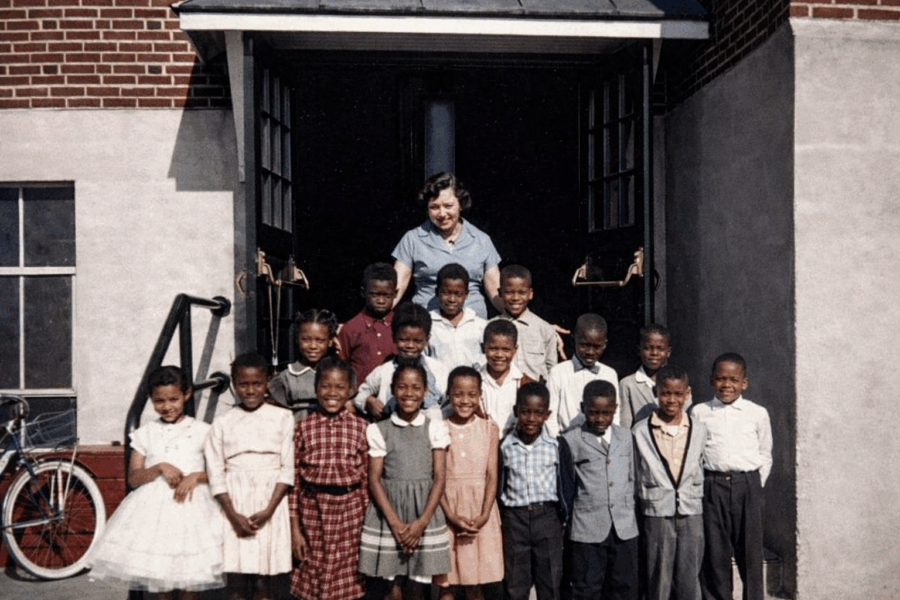
Next time you’re in the Northeast neighborhood of Harrisonburg, look for the Lucy F. Simms Center—a large brick building next to Ralph Sampson Park. If you think it looks like a public school, you are correct. This community center was once the Lucy F. Simms School, a cornerstone of the Black community in Harrisonburg, VA, until it was closed in 1965 as part of desegregation.
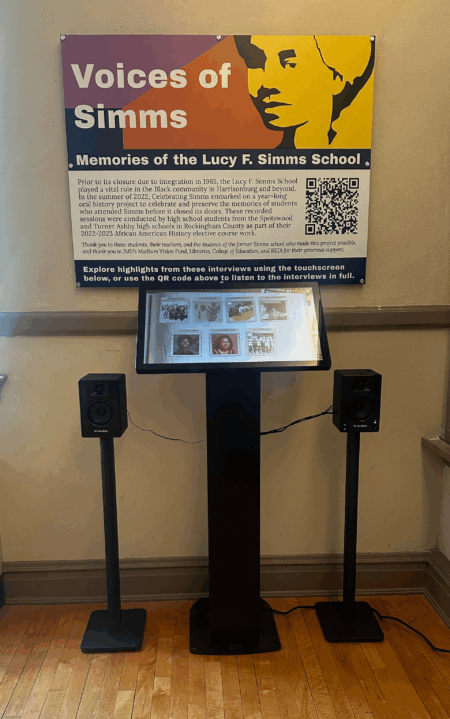
As you walk the halls, if you find yourself wondering what it was like for students here in the 1940s, 50s, and 60s, you have the chance to find out! In the conference room, you’ll find an interactive touchscreen exhibit featuring audio recordings of local community members reminiscing about the Lucy F. Simms school, their beloved teachers, and the vital role the school played in the community.

Sixty-one years later, many former students—now in their sixties, seventies, and eighties— are still living in the Harrisonburg area, and they remember the school as a pillar of the Black community.
“Simms was more than a school,” says Debbie Abernathy, one of the first five Black students to integrate Harrisonburg schools. “It was like our community center … everybody participated … everybody joined … just like everybody would go to church.”
Over the years, many people have told the story of the Simms school. Today, those stories are being intentionally preserved through a partnership between local high schools and James Madison University. High school students enrolled in an African American History elective course recorded oral history interviews with former Simms students, creating authentic, first-hand accounts that become part of the historical record.
“These interviews capture learning and history at its finest,” says Owen Longacre, a history teacher at Spotswood High School whose class participated in the project. “It’s an opportunity for students to interact with individuals who lived the very topics we’re discussing. It’s personal. Students realize these aren’t just people in a book—they’re real, living members of our community with amazing stories to share.”
For students, the experience goes far beyond coursework. “There’s a difference between learning from a textbook and experiencing primary history firsthand,” one student reflected. “Not only did the experience highlight the community at the school, but it showcased how Harrisonburg has developed throughout the years. The experience provided a chance to learn local Black history that would have gone untold in textbooks.”
Another student noted how the project reshaped their understanding of history. “Racial segregation is often taught as ‘old’ history,” they said, “but that’s not true. The Simms experience proves that America’s history with racial issues is modern-day history, with individuals currently living to tell the tale.”
JMU Libraries plays a critical role in making this work possible by loaning audio recording equipment, providing training, and hosting the completed interviews online. In 2023, graduate assistant Mariam Ismail—then a Libraries graduate student and member of the Digital Projects team—helped train high school students in recording techniques, podcasting, and the logistics of oral history work.
“These students were already interested in Black history,” Ismail explained, “but reading about a topic is different than actually engaging with people. You’re asking the questions yourself. You’re interacting with the issues—and with the people behind them.”
Completed interviews are made publicly available through the Celebrating Simms website, which represents the collective work of many community members, educators, and historians, including Billo Harper, Robin Lyttle, Dr. Mollie Godfrey, Dr. Seán McCarthy, JMU students, Grover Saunders, and the rest of the Digital Scholarship and Distinctive Collections Department in JMU Libraries. Together, they ensure that the legacy of the Lucy F. Simms School—and the voices of those who lived it—remain accessible for generations to come.
Learn more: Visit the Celebrating Simms website to hear from students and community members involved in the project and explore full audio recordings and transcripts. If you’re interested in conducting an oral history interview or creating a podcast of your own, contact JMU Libraries Equipment Loans to get started.